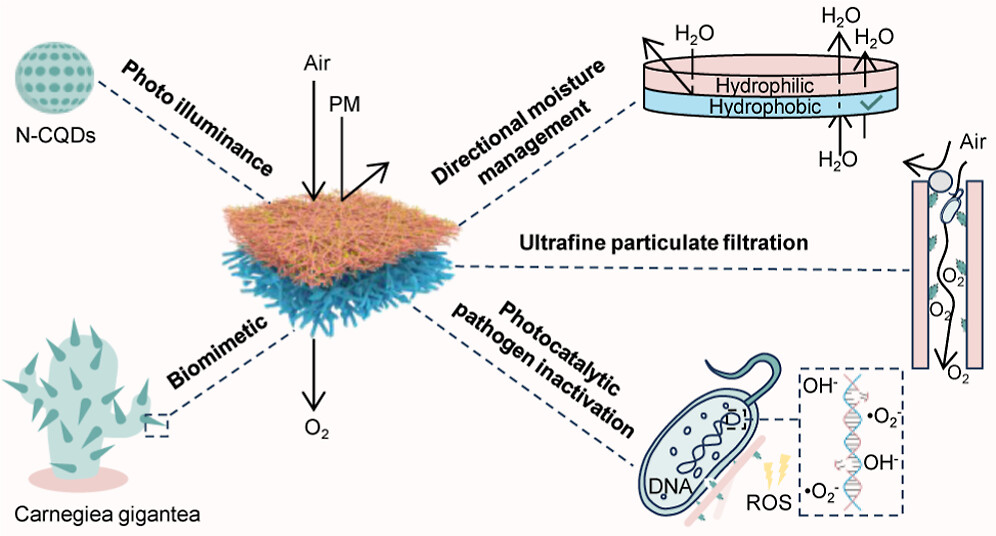
*New publication from EMSR* Airborne pathogens and pollution control typically necessitate multiple membranes, each specializing in efficient aerosol filtration, moisture regulation, or antimicrobial protection. Integrating all these functions into a single membrane is highly advantageous but remains inherently challenging due to material incompatibility and inevitable performance trade-offs. Here, we present a photoactive Janus nanofibrous membrane for highly efficient air purification, engineered via sequential electrospinning. This asymmetric membrane features a biomimetic cactus spine and pollen structures formed within a hydrophilic biopolymer matrix with the embedding of nitrogen-doped carbon quantum dots (N-CQDs) on one side and hydrophobic microchannels on the other, together creating interfacial chemical gradients that drive unidirectional water transport. The nanofibrous membranes exhibit simultaneous size-exclusion sieving and electrostatic capture through quantum-confined charge polarization, achieving over 99.59% retention of PM0.3 aerosols. Under UV activation, the N-CQDs generate tunable reactive oxygen species, enabling contact-free pathogen inactivation, which is further enhanced by water-mediated destabilization of microbial cell membranes, resulting in a 6-log (99.9999%) reduction of both Gram-positive and Gram-negative bacteria within 30 min. The membranes demonstrate exceptional operational durability, retaining 98.5% filtration efficiency after 10 working cycles, outperforming conventional membranes susceptible to water moisture-induced degradation. This work presents a versatile platform for advanced multifunctional air purification membranes, enabling a wide range of applications spanning biomedical isolation gowns, smart ventilation systems, and reusable respiratory devices.
More details available below:
Y. Rao, J. Chen, G. Li, J. Liu, X. Deng, S. Feng, C. Lu, Z. Low, Z. Zhong, W. Xing
ACS Nano, 2025, in press